

How to Find Web Design Clients: 6 Practical Ways
A practical plan for freelancers and small agencies, from a first portfolio example to a qualified conversation and proposal.
To find web design clients, choose a type of business you can help, show a relevant example of your work, and start conversations through introductions, local prospecting, or agency partnerships. Qualify the need, budget, and timing before writing a proposal. A list of businesses becomes useful when you know why each one might need your service.
This guide covers practical ways to find prospects, what to do without a client portfolio, and how to turn an initial conversation into a clear next step. Webdevamin publishes it and builds Webleadr, a paid tool for researching business leads.
Choose a Client and an Offer
Start with a service you can explain in one sentence. “I build websites” leaves the owner to decide how that helps. “I build websites for local painters so customers can see completed work and request a quote” describes both the client and the job.
Choose a category where you understand the customer's questions and can deliver the required website. Our guide to web design niches compares examples. You can expand once you learn which businesses respond and which projects are profitable.
Write down your initial scope: the pages, content, contact or booking features, revisions, and ongoing support you offer. Decide what is excluded. A small, clear project is easier to discuss and price than an open-ended promise to fix every part of a business's online presence.
Find Clients Without an Existing Portfolio
You need evidence that you can do the work, but it does not have to come from a large client list. Build one relevant demonstration site and label it clearly as a concept project. Show the mobile layout, the customer action it supports, and why you made the design choices.
For example, a concept for a cleaning company could show service areas, a service list, common questions, and a quote request form. Explain how the owner would update it and what a customer would do next. Do not present a fictional business as a paying customer or invent results.
If you take on a small first project, agree the scope, fee, responsibilities, and permission to show the work in writing. You do not need to offer unlimited free work or build an entire website before a prospect has agreed to proceed.
Ways to Find Potential Web Design Clients Before You Reach Out
Choose one or two approaches you can keep up with. Compare the conversations and paid projects each produces, including the time spent finding them.
- A useful first action
- Tell relevant contacts which business and problem you help with.
- Main tradeoff
- You depend on the size and fit of your network.
- A useful first action
- Review one niche in one area and identify a specific website gap.
- Main tradeoff
- You must confirm the owner actually wants help.
- A useful first action
- Share a relevant project and your availability with a suitable agency.
- Main tradeoff
- Rates, ownership, and client contact need clear agreements.
- A useful first action
- Respond to a brief that matches work you can show.
- Main tradeoff
- Competition, platform fees, and proposal time affect the return.
- A useful first action
- Answer a real question and contribute useful examples.
- Main tradeoff
- Trust takes time, and promotion must follow the group's rules.
- A useful first action
- Publish a project story for a specific type of client.
- Main tradeoff
- Search visibility and an audience usually take time to build.
| Approach | A useful first action | Main tradeoff |
|---|---|---|
| Personal introductions | Tell relevant contacts which business and problem you help with. | You depend on the size and fit of your network. |
| Local prospecting | Review one niche in one area and identify a specific website gap. | You must confirm the owner actually wants help. |
| Agency partnerships | Share a relevant project and your availability with a suitable agency. | Rates, ownership, and client contact need clear agreements. |
| Freelance marketplaces | Respond to a brief that matches work you can show. | Competition, platform fees, and proposal time affect the return. |
| Business communities | Answer a real question and contribute useful examples. | Trust takes time, and promotion must follow the group's rules. |
| Your own website and content | Publish a project story for a specific type of client. | Search visibility and an audience usually take time to build. |
Ask for Specific Introductions
Tell former colleagues, friends, and business contacts what you are offering. Give them a short description they can pass along, and ask for an introduction rather than someone else's contact list.
I'm taking on a small website project for a local service business. I can help with service pages, project photos, and quote requests. If someone you know is already looking for that, would you be comfortable introducing us?
Research Local Businesses With a Clear Website Need
Look for a business that is active but has a specific problem: no dedicated website, an unusable contact form, unclear services, or a difficult mobile booking process. Check the issue yourself before referring to it in a conversation.
Use the businesses without websites research guide for the manual process. If a business already has a site, our website redesign use case explains the signals worth reviewing.
Webleadr can help organize this work. Choose a location and business type, review the saved leads, and use website signals, notes, and available contact details to build a shortlist. It finds prospects to assess; it does not supply people who have already requested a web design quote.
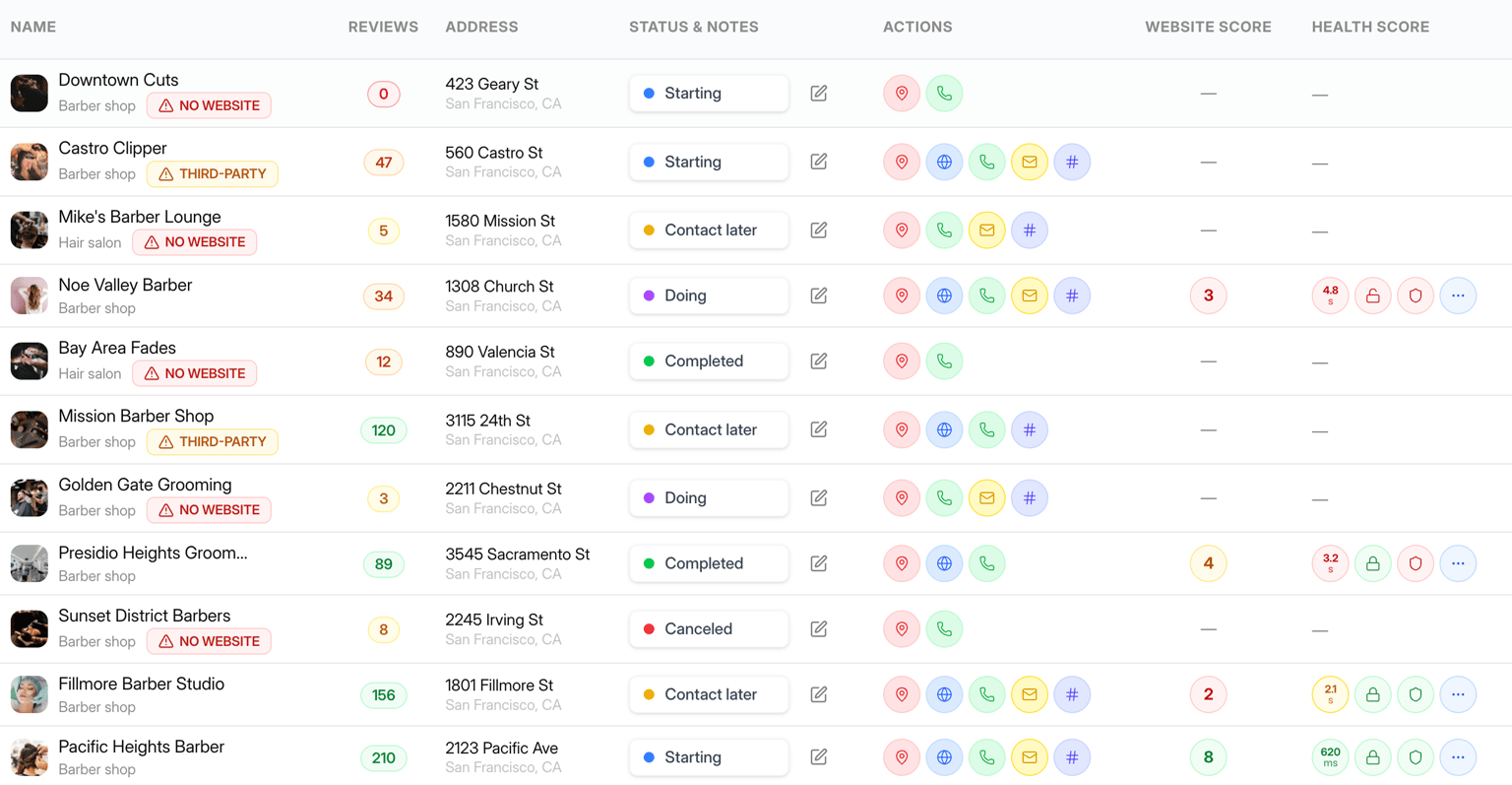
See the web designer prospecting workflow or watch the demo. Check the one-time credit packages if the research fits your way of finding clients.
Partner With Agencies and Related Providers
A branding studio, copywriter, photographer, or marketing agency may have clients who also need a website. Look for a service that complements yours and explain what work you can handle, what you need from a brief, and when you are available.
Agree who communicates with the client, who invoices, whether you may show the work, and who handles support. A small first project lets both sides see whether the working relationship is a good fit.
Respond to Relevant Freelance Briefs
Marketplaces can put you in front of people already looking for help. Select briefs that match your skills, available time, and price range. Refer to the stated problem, show one relevant example, and ask a question that helps define the project.
Account for current platform fees and the time spent proposing when judging whether this approach pays off. Competing on price alone can leave too little room for revisions and support.
Participate in Business Communities
Choose communities your clients use, such as a local business association or a trade group. Answer questions about matters you understand and show an example when it helps. Follow the rules on promotion and ask before sending a sales message.
Make Your Own Website Useful to Buyers
Show who you help, the work you deliver, and how to discuss a project. For each portfolio example, explain the initial problem, your role, the scope, and the result you can substantiate. Include a contact route that works on mobile.
Write about the questions your prospects ask, such as what they need to prepare for a website project or how a quote form would fit their business. Shopify's guide to finding web design clients also discusses proposals, events, referrals, and inbound marketing as ways to develop a client pipeline.
What We Learned From Local Outreach
In one local outreach attempt, we gained two clients after a full day of speaking with businesses in person. This is one experience from our own work, not a typical result or a forecast for your business.
The useful lesson was that a conversation gave us room to understand the owner's situation before suggesting a website. You can apply that approach in a meeting, on a call, or in an agreed online conversation. Be honest about where you are based and the service you can provide.
Qualify a Lead Before Pitching
A poor website or missing website does not establish that the owner wants to replace it. Ask a few questions before investing in a detailed proposal:
- Need: What is difficult about the current way customers find information, book, or request a quote?
- Priority: Is fixing that problem something the business wants to do now?
- Decision: Who will approve the project and provide the content?
- Budget: Is the owner's expected spend compatible with the scope you can deliver?
- Timing: Is there a real deadline, and can both sides make time for the work?
- Fit: Would a website solve this, or would a smaller change to an existing tool be enough?
Record the answers and the agreed next step. A clear “not now” is useful information and can save both sides time.
How to Approach Local Businesses
Use one accurate observation and one easy question. Ask whether it is a convenient time to speak, and explain your role without pretending to be a customer or an existing contact.
For a business where you could not find a website:
Hi, I'm a web designer working with service businesses. I found your business on Maps, but couldn't find a website explaining your services. Do you already have one? If not, is that something you want to discuss?
For an existing website with an issue you have checked:
I tried your quote form on my phone and couldn't complete the service selection. Is that a problem you've noticed too? If it is something you want to fix, I can explain how I would approach it.
These are example conversation openers. Adapt them to what you actually observed. Avoid claims that a new site will guarantee rankings, bookings, or revenue.
If the owner is interested, suggest a short conversation about their needs. Webleadr's outreach message and call-script workflow can help prepare a draft from a lead's details, but you should check its accuracy and tone before using it.
Choose a Suitable Contact Channel
Use the business's stated contact preferences and respect a request to stop. A published email address or phone number does not automatically mean permission for marketing. Check the rules that apply to your location, the recipient, and the channel before starting outreach. The UK ICO's direct marketing guidance is one starting point for UK campaigns; requirements differ elsewhere.
When someone agrees to hear more, keep the follow-up tied to the discussion. Remind them of the problem, summarize the next step, and make it easy to decline. Do not switch channels repeatedly to pursue someone who has said no.
Turn a Conversation Into a Proposal
Send a short written proposal once you understand what the owner needs. Include the business problem, the proposed work, the price, the payment schedule, the timeline, and what you need from the client.
Make responsibilities clear. Who supplies the wording and photos? Who owns the domain and accounts? What revisions are included? Who handles updates, hosting, and support after launch?
For an illustrative painting business, the scope might be a service page, a gallery using client-approved photos, and a quote form. A booking system or ongoing marketing work would be a separate discussion. Explain what you will build and how you will check that it works, without promising a particular number of customers.
Turn Happy Clients Into Referrals
Ask for a testimonial or introduction after delivering work the client is happy with. Make the request specific: “Do you know another service business that needs a clearer website?” Ask permission before using their name, quote, or project in your marketing.
Keep supporting the agreed work. A helpful handover and clear maintenance arrangements give clients a reason to recommend you. If you offer a referral reward, explain the terms openly.
A Practical First-Week Plan
This is an example work plan, not a promise of landing a client within a week. Adjust it to your time and experience.
- Day 1: Choose one business category and define a small website offer.
- Day 2: Prepare a relevant portfolio example or clearly labeled concept.
- Day 3: Research a shortlist of ten businesses and verify a useful reason to approach each.
- Day 4: Ask for introductions and start a few appropriate conversations.
- Day 5: Follow up where agreed and discuss scope with interested owners.
- At the end of the week: Review which approach led to relevant conversations, proposals, and paid projects. Change the offer or audience if there is a repeated mismatch.
Track the source of each lead, time spent, conversation outcome, proposal value, and whether the project was won. This helps you decide where to spend the next week, even when the answer is that you need better prospects or a clearer offer.
Build a Shortlist You Can Act On
Start with a clear offer, credible work, and a small group of relevant businesses. If local research is your chosen approach, see how Webleadr finds businesses without websites. When you are ready, create an account and choose a credit package to begin researching. Qualification, useful conversations, and a clear proposal remain part of the work.
FAQ
Tested Webleadr recently after finding out about it. I got a dozen strong leads in my city Munich. Generally well designed and useful tool for finding leads. I recommend.